Water purification domain has undergone a revolution thanks to reverse osmosis (RO) technology, which offers a practical way to get clean, safe drinking water. A reverse osmosis machine has emerged as a crucial player in the fight against water contamination because of its sophisticated filtration mechanism.
In order to guarantee access to high-quality drinking water, in this article we comprehensively discuss reverse osmosis and how water purifiers rely on reverse osmosis systems.
Read more: Explore domestic water purifiers e.g. Undersink water purifiers
Understanding Reverse Osmosis Machines
Reverse osmosis is a process by which water is purified through the use of a semi- permeable membrane that filters out dissolved solids such as salt, impurities and other contaminants.
During this process pressure is applied to push water from solutions with high concentration of contaminants to solutions with low concentration of contaminants.
Contaminants remain trapped by the semi-permeable membrane. The solvent molecules move from a low concentrated solution to a high concentrated one.
It’s worth noting that the pressure applied during reverse osmosis should be greater than osmotic pressure in order to push water in an opposite direction. As the name implies, reverse osmosis turns this natural process inside out by providing pressure to drive water molecules through the membrane while removing impurities.
The Reverse Osmosis Machine: The solution you need for water
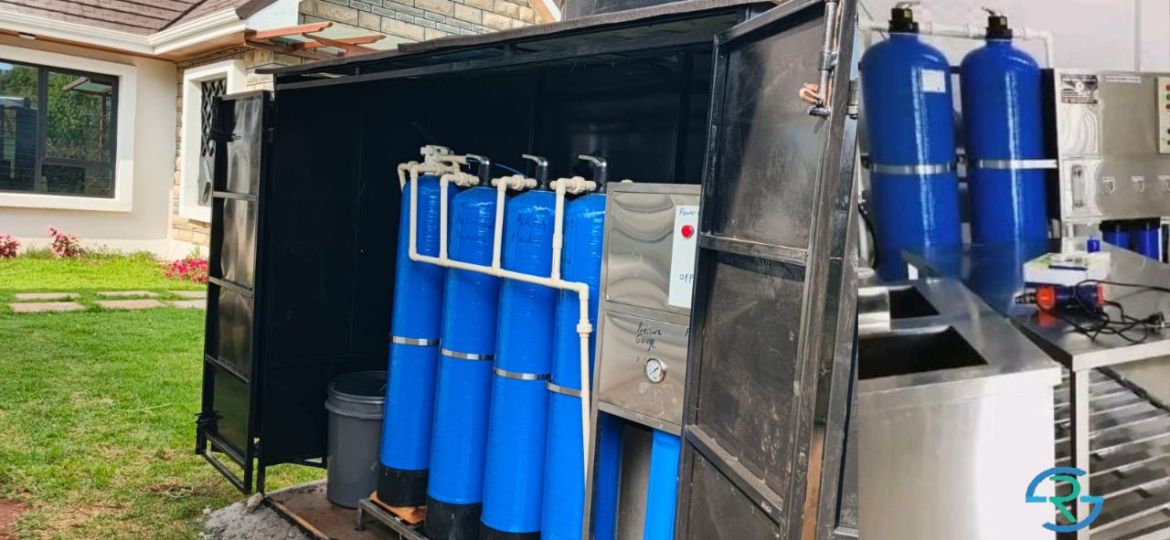
The core of the reverse osmosis purification process is a reverse osmosis machine, sometimes referred to as a RO system. It is made up of several vital parts that cooperate to deliver clean, filtered water:
Pre-Filters: By removing silt, chlorine, and other bigger particles, these first filters in the reverse osmosis machine tend to guard against harm to the sensitive membrane.
Reverse Osmosis Membrane: The semipermeable membrane, which is the brains of the device, serves as a wall, letting only molecules of pure water pass through while obstructing pollutants including bacteria, viruses, heavy metals, and dissolved solids.
Post-Filters: By removing any lingering contaminants and odors, these last filters improve the water’s flavor and purity while also providing additional purification.
Storage Tank: To provide a steady supply of clean water, the reverse osmosis machine is often connected to a storage tank that retains the filtered water until it is ready for use.
Water is dispensed through a special faucet or dispenser, and is then ready for use in a variety of home and commercial applications.
The “Team Effort” within the Machine
If you tried to remove silt using only the RO membrane, the machine would break very quickly. Here is why the multi-stage setup is necessary:
Stage 1 (Sediment Filter): Removes the silt. This “bodyguard” stage protects the expensive RO membrane from getting clogged or “blinded” by large physical particles.
Stage 2 (Carbon Filter): Removes chlorine and chemicals that could chemically damage the membrane.
Stage 3 (The RO Membrane): This is where the salt, heavy metals, and arsenic are stripped away.
Summary
Silt is caught by the pre-filters (mechanical filtration).
Salt is removed by the membrane (osmotic separation).
Reverse osmosis applications
- Desalination- reverse osmosis is largely applied in production of drinking water from brackish water sources and seawater. This has improved water scarcity management especially in the coastal regions.
- Wastewater treatment- purification of wastewater such as surface water contaminated with industrial chemicals, is mostly conducted through reverse osmosis.
Production of ultrapure water- reverse osmosis has made it possible to produce ultrapure water from drinking water to meet the required qualification of the electronic industry.
Benefits of reverse osmosis
It is highly effective – Reverse osmosis removes almost all contaminants, that is about 99% of the contaminants. These include heavy metals, dissolved solids and microorganisms.
Safer for the environment – Water purification through reverse osmosis is better for the environment. This is because it does not involve production and disposal of plastics which causes pollution to the environment.
Versatility- the systems used in reverse osmosis can be designed to hold numerous water sources such as groundwater, wastewater, surface water and seawater.
Without a doubt, the reverse osmosis machine has proved to be a groundbreaking technology in matters of water purification. The same has resulted in increased access to clean and safe water for human consumption.
As technology continues to evolve, we continue keeping you updated on recent trends introduced in reverse osmosis machines. Already all our machines at our Ruiru store apply an advanced filtration process.
These water purification machines are delivered to you, installed and tested at a friendly price. It’s your turn to embrace reverse osmosis technology. Contact us now – 0715 535 089
Explore our Water Purification Solutions